
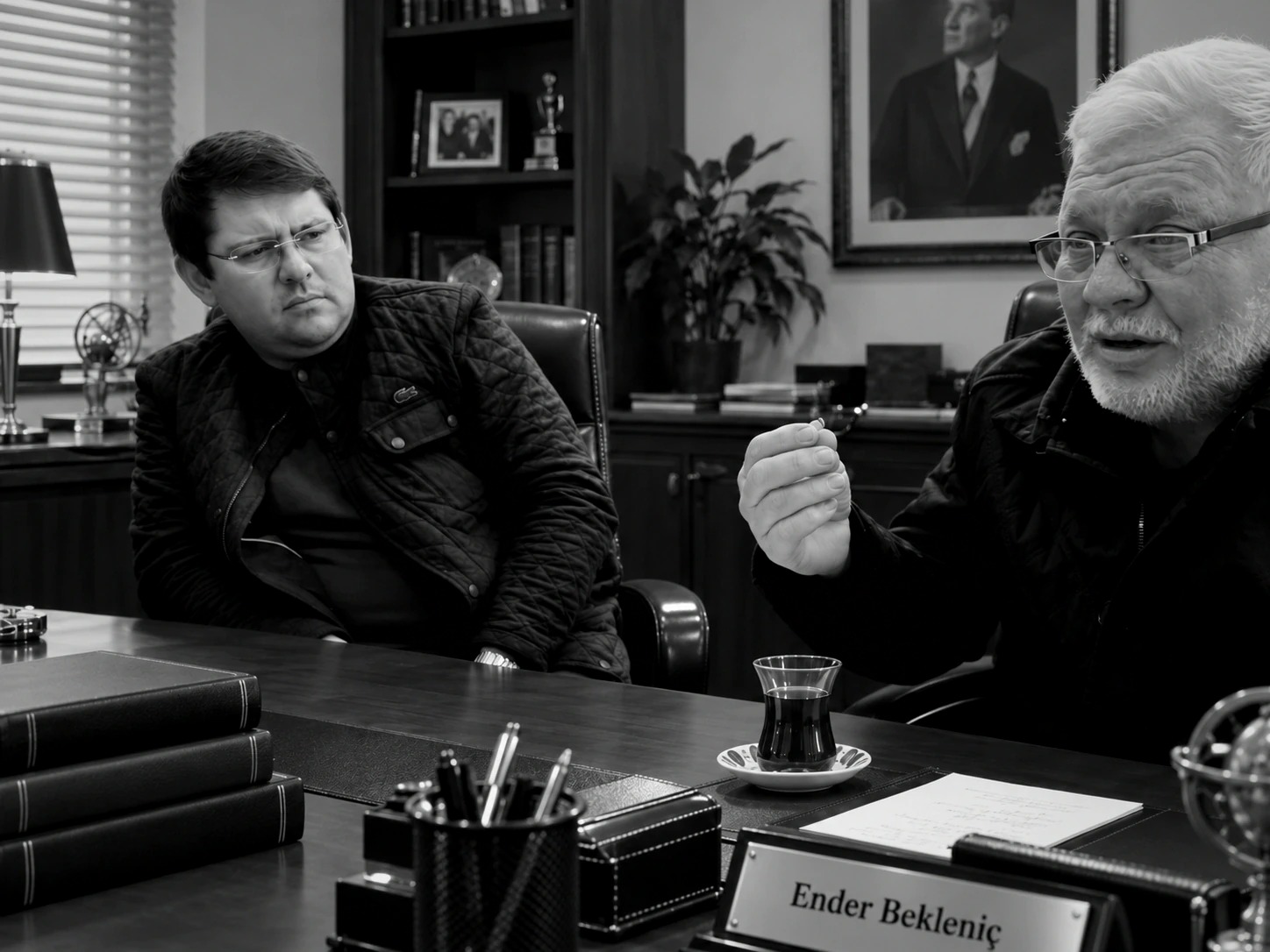
A lifetime in industry
A master who knew the fire of steel and the language of the rolling mill.
Some people leave behind more than completed projects. They leave a standard—of precision, discipline and character—for how work should be done.
Ender Bekleniç devoted a career spanning nearly half a century to the construction of iron and steel plants, rolling technology and the safe commissioning of production lines. Across projects extending from Türkiye to Central Asia and from the Middle East to the Gulf, he became one of the defining representatives of a generation that turned ideas into working plants.
Rolling specialist · Industrialist · Man of the field
Building a plant is not finished until it draws its first breath.
From his first major industrial site to the final acceptance test: the same attention, responsibility and passion for production.
01 / Chronological record
A lifetime. Countless first heats.
The story that began in Adana became an industrial memory through major sites, teams that crossed borders and plants brought into production.
Roots and technical formation
An engineering mind shaped by industry.
Ender Bekleniç was born in Adana into an industrialist family. In an environment where production was a natural part of daily life, he developed a strong work ethic founded on labour, technical rigour and responsibility for one’s word.
He completed his higher technical education within the technical-college system of the period. As a member of a generation that tested classroom knowledge in the field, he developed expertise extending from the drawing board and installation to cold testing and first production.
İskenderun Iron and Steel
The first major industrial site of his career.
Ender Bekleniç’s professional journey began in 1973, during the establishment of the İskenderun Iron and Steel Works. Ground was broken for this major investment in Payas in 1970, and its facilities were progressively commissioned from 1975 onward; it became the first large-scale school of his professional life.
There he learned that heavy industry is not made of machinery alone, but of correct sequencing, millimetric alignment, coordination across teams and countless invisible details that must be completed before production can begin.
Expanding industrial infrastructure
Years in the field, from installation to commissioning.
After İsdemir, he assumed responsibility for installation, assembly and commissioning across major Turkish industrial operations including HABAŞ, Noksel and Çolakoğlu Metallurgy. HABAŞ’s flat-products, wire-rod and bar lines, together with Çolakoğlu’s rolling infrastructure, were among the principal project sites aligned with his expertise.
Every new plant meant a different team, technology and production objective. Ender Bekleniç turned that diversity into a shared engineering discipline built around solving problems in the field.
International reach
The same installation discipline across four regions.
His professional journey extended beyond Türkiye to Turkmenistan, Iraq, Oman and Kazakhstan. He took part in installation and commissioning work for pioneering iron and steel investments of their time, bringing teams operating under different conditions together around a common production objective.
Bringing a plant to life in a new country required more than technical competence; it demanded cross-cultural coordination, logistical foresight and fast decisions in the field. His defining strength was managing every element within one chain of responsibility.
Next-generation flat-steel investments
The scale grew. The precision never changed.
MMK–Atakaş, Tosçelik Osmaniye Flat and Structural Steel, HABAŞ flat-products and coil lines, and Çolakoğlu Metallurgy were among the major industrial projects for which Ender Bekleniç assumed responsibility as a main contractor or subcontractor.
Tosçelik’s rapid investment phase, which began in 2008 and brought the hot-rolling mill into production in 2009, and MMK–Atakaş’s large-scale flat-steel complex in Dörtyol opened a new chapter in the region’s industrial transformation. Across hot and cold rolling, continuous pickling, galvanising and coating lines, he retained the same command of the field and commissioning expertise.
Global technology partners
A trusted bridge between engineering and execution.
He worked as a subcontractor on turnkey projects by global plant and process technology providers including Danieli, SMS group and Primetals Technologies. From mechanical installation and site coordination through cold and hot testing to performance acceptance, he united technical knowledge with execution capability.
Those who knew him remember more than completed plants: they remember an industrialist who remained calm in difficult moments, identified problems at their source and never left the site before the production line was running.
02 / Project footprint
Plants changed. His standard never did.
İsdemir
HABAŞ flat products
HABAŞ wire rod and bar
Noksel pipe production lines
Çolakoğlu Metallurgy
MMK–Atakaş flat steel
Tosçelik flat steel
Turkmenistan
Iraq
Oman
Kazakhstan
Installation · mechanical assembly · alignment · site coordination · cold testing · hot commissioning · performance acceptance
03 / His standard of work
Knowledge acquires meaning only when carried with responsibility in the field.
See the work at its source
Understand the problem at the machine, not in a report; make decisions according to real conditions in the field.
Get it right the first time
Treat every detail—from alignment and assembly to testing and production—as a duty that determines the reliability of the outcome.
Deliver a plant that runs
Consider a project complete not when the drawings are finished, but when the line has entered stable production.
04 / The legacy carried by Bortel
His discipline lives in every step of production we take today.
The greatest legacy Ender Bekleniç left is not simply a list of completed plants. It is the ability to solve problems under difficult conditions, treat one’s word as a commitment, respect technical detail and regard production as a responsibility to the country.
Bortel Copper embraces this legacy not as a memory confined to the past, but as a living discipline of production to be carried into the future through technology, quality and a new generation of industrial thinking.
This corporate narrative was prepared by considering the family archive, the collective memory of his professional projects and the publicly available histories of the relevant industrial organisations.